Services

Enterprise services for cloud, data, and AI modernization

From AWS-native architectures to Snowflake, Databricks, Oracle, and Teradata modernization, we deliver an executive-ready roadmap with measurable outcomes. We align strategy and engineering so your data platforms are resilient, cost-efficient, and AI-ready.

Know your data, workloads, and system architecture before you scale.

Ecosystem alignment

Enterprise-grade

Architecture and delivery playbooks tuned to regulated, high-scale environments — spanning AWS, Snowflake, Databricks, Oracle, and Teradata estates.

AWS Snowflake Databricks Oracle Teradata Hybrid

Cloud and Data Architecture Consulting

Reference architectures aligned to business objectives

We define cloud and data platform blueprints that balance latency, compliance, and scale across AWS, Snowflake, Databricks, Oracle, and Teradata estates.

  • Solves fragmented data domains, inconsistent governance, and legacy constraints.
  • Outcomes: faster architectural decisions, reduced rework, clear modernization path.

Platform Migration and Modernization

De-risked migrations with measurable uptime and cost impact

We orchestrate phased migrations from legacy platforms to cloud-native stacks, with parallel run strategies and governance that enterprise leaders can trust.

  • Solves stalled migrations, vendor lock-in, and operational disruption risk.
  • Outcomes: predictable cutovers, continuity assurance, accelerated cloud adoption.

Data Warehousing and Lakehouse Strategy

Enterprise data foundations that scale analytics and AI

We design lakehouse and warehouse strategies that unify governance, operational reporting, and advanced analytics with Snowflake, Databricks, and AWS.

  • Solves duplicated pipelines, data quality gaps, and slow analytic cycles.
  • Outcomes: trusted data products, faster insights, AI-ready datasets.

Performance Engineering

Latency reduction and throughput at scale

We analyze workload patterns, pipeline parallelism, and query execution for enterprise-grade platforms, delivering performance gains without sacrificing reliability.

  • Solves slow dashboards, pipeline bottlenecks, and resource contention.
  • Outcomes: optimized SLAs, faster decision cycles, higher system utilization.

Cost Optimization

Sustainable cost control without sacrificing scale

We identify savings across compute, storage, and licensing models for AWS, Snowflake, Databricks, Oracle, and Teradata — with governance that sticks.

  • Solves runaway cloud spend, underutilized capacity, and unclear chargeback.
  • Outcomes: lower unit costs, predictable budgets, improved ROI.

Generative AI Systems Architecture

RAG and agentic systems built for enterprise governance

We architect secure AI pipelines, retrieval layers, and observability controls that tie LLM performance to trusted data products.

  • Solves AI risk, data provenance gaps, and fragmented experimentation.
  • Outcomes: faster AI deployment, compliant usage, measurable business impact.
Ready to evaluate your modernization roadmap?

We provide executive-ready assessments in 2–4 weeks with quantified outcomes and delivery options.

Services • Data Platform Modernization

ETL and ELT, Explained for Enterprise Decision-Makers

Modern data platforms demand clarity on where transformations run, how governance is enforced, and which approach delivers reliable outcomes. This guide defines ETL, outlines when it remains the right choice, and compares it with ELT in cloud-first architectures—so your teams can align performance, compliance, and cost with business priorities.

Executive Summary

  • ETL prioritizes controlled transformations before load, ideal for legacy systems and tightly regulated workloads.
  • ELT shifts transformation into cloud platforms such as Snowflake or Databricks for elasticity and rapid iteration.
  • Governance, latency, and cost models determine which pattern protects data integrity while scaling efficiently.
ETL Extract • Transform • Load

What ETL is

ETL orchestrates data extraction from source systems, transforms it in a controlled staging environment, and then loads curated datasets into a warehouse or data lake. This approach emphasizes predictable transformations, centralized quality checks, and strict lineage tracking before data is consumed.

When ETL is preferable

  • Legacy systems requiring tight schema control (Oracle, Teradata).
  • Regulated environments where validation must occur before load.
  • Highly sensitive data with strict masking or tokenization policies.

Enterprise example

A global bank stages data from Teradata into governed landing zones, applies compliance transformations, then loads curated tables into Snowflake for downstream analytics.

ELT Extract • Load • Transform

What ELT is

ELT loads raw data into a modern cloud platform first, then performs transformation inside the platform’s compute layer. This pattern leverages elastic scaling, avoids duplicate storage layers, and supports faster iteration for analytics, ML, and generative AI workflows.

Where ELT shines

  • Cloud-native platforms (Snowflake, Databricks, AWS Lakehouse).
  • High-volume data streams that benefit from elastic compute.
  • Teams needing rapid experimentation and iterative modeling.

Enterprise example

A retail enterprise loads raw clickstream data into Databricks, then runs ELT transformations to build customer behavior models for real-time personalization.

ETL vs ELT Comparison

A clear decision framework

Know your data, workloads, architecture

Transformation control

ETL centralizes transformation logic before load, ideal for data quality assurance and consistent business rules. ELT distributes transformations across platform-native tooling, which demands strong model governance and testing discipline.

Governance and lineage

ETL aligns with regulated workloads that require strict lineage before data lands in production. ELT can meet the same standard when paired with cataloging, policy enforcement, and role-based access controls.

Latency and freshness

ETL can slow delivery when middleware transformation queues are saturated. ELT often reduces time-to-insight by transforming data within the warehouse or lakehouse as compute becomes available.

Platform fit

ETL aligns with stable schemas, mainframe or legacy data sources, and standardized pipelines. ELT is a natural fit for Snowflake, Databricks, or AWS-native data lake architectures built for elastic compute.

Hybrid reality

Most enterprises run a blend: ETL for regulated, high-assurance domains and ELT for scalable analytics, AI, and experimentation. The right mix depends on data sensitivity, transformation complexity, and how quickly decision-makers need insights.

How we advise on ETL vs ELT

We assess platform capabilities, governance maturity, and workload profiles to recommend the transformation strategy that delivers measurable performance gains and cost efficiency. Our advisors map enterprise data flows across AWS, Snowflake, Databricks, Oracle, and Teradata ecosystems to ensure every modernization step is auditable and aligned with business outcomes.

Modernization Roadmaps Cost & Performance Modeling Governance by Design

Consultation Prompt

Need to decide whether to modernize your ETL stack, shift to ELT, or run a hybrid strategy? We help enterprise leaders quantify latency, compliance, and total cost of transformation before choosing a path.

Pipeline parallelism playbook

Scalable data processing that respects dependencies, speed, and cost.

We design pipeline parallelism strategies that partition intelligently, orchestrate workloads with precision, and exploit distributed execution across AWS, Databricks, and Snowflake. The result: faster time-to-insight, predictable performance under concurrency, and resilient, right-sized architectures that lower total cost.

Know your data, workloads, and system architecture—only then scale with confidence.

Partitioning & ingestion

Shape data domains, shard by business keys, and align parallel ingestion with AWS Glue, Kinesis, and Snowpipe to maximize throughput without over-amplifying downstream load.

Workload orchestration

Coordinate DAGs with dependency-aware schedulers, aligning Airflow, Step Functions, and Databricks workflows to reduce idle time and enforce SLAs.

Distributed transforms

Use Spark execution plans, Delta Lake optimizations, and Snowflake warehouses for high-parallel transforms with clear trade-offs between cluster size and job latency.

Concurrency control

Right-size concurrency with Snowflake multi-cluster settings, Databricks job clusters, and AWS Lake Formation governance to prevent noisy-neighbor degradation.

Dependency management

Model upstream and downstream dependencies, enforce data contracts, and maintain recovery checkpoints to keep enterprise pipelines resilient.

Performance trade-offs

Balance batch size, parallelism levels, and cache strategy to avoid runaway costs while sustaining predictable throughput.

Architecture snapshot

Parallelism layers
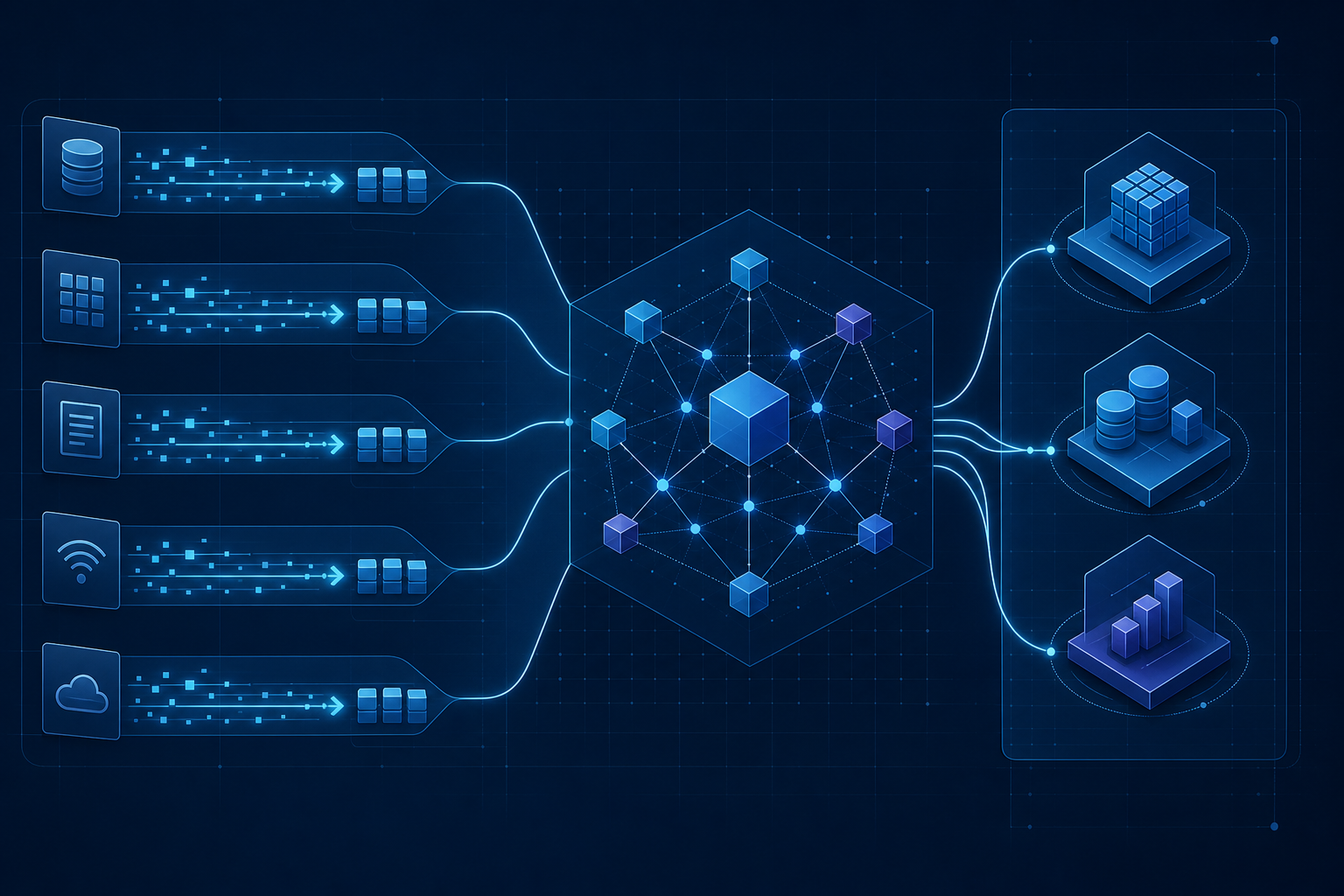
Abstract architecture diagram showing parallel ingestion lanes feeding distributed transforms and governed data products
Ingestion lanes feed distributed transforms and controlled concurrency tiers. Dependencies and recovery checkpoints enforce resilience across AWS data services, Databricks processing, and Snowflake workloads.

Value delivered

  • Time-to-insight improves with parallel ingestion and balanced transforms.
  • Predictable performance through concurrency controls and right-sized compute.
  • Resilience from dependency-aware orchestration and recovery checkpoints.
  • Lower cost with precise parallelism thresholds and workload isolation.

Retrieval-Augmented Generation

Enterprise RAG that anchors AI in trusted knowledge

Retrieval-Augmented Generation (RAG) replaces guesswork with verifiable context. By grounding responses in enterprise data, policies, and technical documentation, RAG delivers AI outputs that are relevant, defensible, and aligned with governance standards. We design RAG systems that treat your knowledge base as a first-class product: curated, versioned, observable, and secure.

Why agentic systems demand robust retrieval design

Agentic workflows make multiple tool calls, chain reasoning steps, and operate under time pressure. Without high-quality retrieval, agents drift into stale content, unauthorized domains, or irrelevant results. Strong retrieval design ensures each step is guided by the right source, with deterministic controls over cost, latency, and output quality.

  • Precision indexing and chunking for multi-step reasoning
  • Role-aware retrieval to respect security boundaries
  • Observability for recall, relevance, and traceability
  • Latency-aware pipelines to support real-time agents

Architecture choices that control risk and value

RAG architecture is more than a vector store. Data synchronization, retrieval routing, and inference placement determine how systems scale, what they cost, and how they meet governance expectations. We align architecture decisions with enterprise priorities: compliance, performance, and measurable outcomes.

Latency

Hybrid retrieval with caching, tiered indexes, and parallel pipelines keeps response times consistent under load.

Cost

Right-size embedding strategies, minimize token spend, and route to smaller models where appropriate.

Governance

Access control and lineage track which sources informed every answer and why.

Relevance

Semantic + keyword blends improve recall for regulated content and exact identifiers.

Patterns for structured and unstructured enterprise knowledge

Structured data

Use metadata-aware retrieval over Snowflake, Databricks, or Oracle sources; map business entities to canonical IDs for grounding.

Unstructured content

Apply enterprise chunking strategies for policy docs, runbooks, and product manuals; preserve headings and citations.

Security boundaries

Segregate retrieval indexes by tenancy, region, and role; enforce zero-trust access at query time.

Observability

Track relevance score distributions, retrieval latency, and hallucination risk across releases.

Know your data, workloads, and architecture

The classical maxim becomes an engineering imperative: credible AI begins with knowing your sources, workloads, and system constraints. We guide enterprises to build RAG systems that executives and auditors can trust.